I have frequently caught myself saying that all the growth people told me would happen to me in college, has more effectively occurred here in the Peace Corps for me. Granted the next question following that is usually along the lines of “what has changed?” Well, then starts the stuttering and the blank mind because putting it into words is often more difficult than I expect. But perhaps it’s not that I’ve changed so much as I’ve become more self aware, and ideally in most situations more confident.
One place where my confidence still lacks is in putting myself into a situation where I have the potential to, at least in my eyes, embarrass myself. I suppose if we looked back in the crystal ball or through some psychological analysis we could come to various events in my development that impeded my growth as a confident outgoing individual. The most obvious was a certain picture of me in clothing not appropriate to my gender that got to school and was that quintessential gaffe that someone becomes known for. I really feel as though it was some time earlier as I can recall those concerns before then, but in elementary school I remember often feeling exceedingly confident and capable, which was, in hindsight, a product of my ability to digest information very quickly. When I was young (haha I’m 23 so that’s kind of a ridiculous statement but you know what I mean), I learned very quickly and so I think I probably was a step ahead of most that surrounded me, which would naturally give anyone confidence. However, I think my early successes did not develop in me an ability to bounce back, for lack of a better way to say it. So as I grew up, I continued to get myself into the company of people who I would consider truly brilliant. Yet I failed to see that while I was not the smartest, best, or most capable, I was absolutely not the other end in any categories. I just failed to see beyond the first part. IB, orchestra, athletics, all of which carried over to college at Cornell where there are herds of geniuses running around. Even now, in Peace Corps, the people here come from a slice of America that is…impressive, at the very least. Just considering these peoples’ secondary education achievements and it is quite the group of individuals. Anyway, I set a high bar for myself, but when I fail to clear the bar, I never really deal with it. I just kind of feel sad for a little while, think self-deprecating thoughts, and sit with my tail between my legs before moving on to the next thing and put it out of my mind.
I’m curious to know what that might have lost me. I think as a musician I was only as good as my concern for failure would let me be. I hate(d) solos because it was me and my warts for all to see where as the further into a group I was the better I felt. I know for a fact my best quality viola playing was in a massive orchestra where I was completely covered. Yet somehow I couldn’t translate that quality to when I would play alone, and that made it all the harder to keep my confidence at a level even basic skills needed to succeed. Vocally, I was much more comfortable and that allowed me to do things like Madrigals. Still, when it came time for me to sing alone in front of a piano, or heaven forbid, in front of the auditorium, I got extremely nervous, to the point where it was difficult to do things that were automatic at most times.
I suppose I could also list the number of relationships that didn’t, or at least couldn’t, happen due to my lack of confidence. I’m fairly certain at least one relationship I had was sabotaged by my lack of self-confidence. And I had several situations when a less concerned person would put himself out there. But despite myself, I’m in a very good place on that front! Since I tried so hard to avoid getting myself into a situation where I could get hurt, I waited until I couldn’t not pursue the relationship and it has worked out wonderfully.
Anyway, to get where this is going, I’ve found my new confidence dependent issue. Language. Somehow, standing in front of a classroom teaching material I learned the night before is not a huge concern for me. However, I can’t deny that the teaching profession is in my blood so maybe I have some help in that department. But my language ability is less than what it should be and even with effort to practice grammar and improve vocabulary, I’m way behind. I have all these excuses ready to flow out for why I don’t understand when all my peers seem to do better than me with the language. My host family spoke mostly English, I teach in English, I don’t live in a situation where I even have to speak English, and the current hot one, it’s easier if they speak so there isn’t confusion so I’ll stand in the back. The reality, however, is that I just don’t try as hard as I should and I don’t try because I’m worried what will happen when I make a mistake. I’m not really sure how to correct this fault of mine but being aware that it is often a problem far greater than trying and failing is a first step. That’s not to say I wouldn’t have agreed with that statement in the past, but I would have found some excuse for why it didn’t apply in that situation. I would rather not ruin a good friendship, or I don’t want to say something offensive. I can’t say I know what I need to do now, or every situation will be met with the appropriate internal preparation, but I do need to deal with this. When it makes me avoid buying wood for months because I’m worried about vocabulary I need to do something. And today I did AND I said something that made absolutely no sense. But I laugh about it, and learn. And tomorrow, I’m that much better a Swahili speaker.
All in all I realize this is cliché. Yet, it’s a battle I constantly wage….still. I’m sure, now, it will be one I fight for the duration of my life, but maybe putting myself here in a world where my ability to survive is tied to doing things that make me uncomfortable will prove to myself I can do whatever it is that makes me so nervous.
Tuesday, October 12, 2010

Monday, October 11, 2010
If you give a man a fish, you feed him for a day....
I had an interesting experience today. So this past weekend, after a 2 night stay at Matema Beach, I found my way back home with about 5000 shillingi to spare which was all part of my plan to limit my spending. Although, frequently not taking a lot of money just turns into more excessive borrowing but I like to think it instills some frugality that would otherwise be lacking. Anyway, my fortune in being near an ATM allows me to extend my wallet somewhat in that I can refill the immediate wallet with the bigger bank wallet in less than 5 minutes. However, this also depends on the ATM functioning, which in any western world country would be a valid assumption, but as you might have noticed, I am not in the western world. Therefore, the ATMs break down with some frequency and Sunday night happened to be one of those nights. Compounding that problem was my friends’ needs to travel places either that night or the next day and they had essentially no money themselves. Therefore, my 5000 shillingi went to travel expenses for the friends and I was left with about 400 shillingi in change. Not to worry! I had a just eaten a small pack of spaghetti and a sauce made of my spices and some oil. I also had a couple slices of bread.
Ok, so fastforward 18 hours. I figure when I start getting hungry I can go out to get money then food today. Well, that didn’t quite go as planned as the ATMs were out of money today. At this point, my food intake has been about 2 slices of bread dipped in some olive oil for the last 22-24 hours, not entirely as planned but fixable when the ATM is working. But alas, it is not. So, my friend Linda and I scrape together 1000 shillings between us. I have an avocado and an onion at home, so we decide to buy chapati (basically tortillas) and make some rudimentary guacamole for food. With 2 and a half small-plate-sized chapati and maybe 4 spoonfuls of guacamole, I am now satiated for the short term. However, given the money situation, I’m not sure what I am going to be able to do. I do have a couple potatoes, so I wont starve, but after that, if the ATM doesn’t work tomorrow? Well, fortunately, we were able to go back to the ATM a bit ago and I’m happy to say they are restocked and we were able to take out money. However, I can’t remember a situation where I was literally out of food and out of money to the point where I was worried about where my next meal would come from.
Now, at this point, a lot of people would point out that many people here in Africa do live that way, and maybe that number is larger than what I see, but I find that it’s not the situation most frequently found here. Granted, a caveat for me is that I live in quite possibly one of the most fertile valleys in the country, and perhaps the continent or even the world. Growing food here is not hard. With the frequency of rain and the rich volcanic soil, sustaining yourself is as simple as throwing seeds out back. What we do have here, and it is present even in my school, is malnutrition and an unbalanced diet. People here can afford food to sustain them. Maize grows at least as fast as the weeds here and they ground that up into the country’s favorite dish: ugali. Imagine a cornbread batter that’s half cooked and that’s kind of the idea of ugali. The problem is it is ALL filler. It has almost no nutritional value in terms of vitamins and minerals etc. Yet that is the base of every meal here, then you add beans and maybe some greens, which gives you malnutritioned kids with full stomachs. It’s interesting, the biology syllabus in school is supposed to teach about nutrition and healthy diets, but no one sees that as more than an academic exercise. But then again, why would you try to eat healthy if sickness isn’t a product of what you put in your body but rather God’s will alone.
In my experience, education is what is most needed. Education that eating a balanced nutritious meal will save you time and money in the long term with better health even if it cost a bit more in the short term. Or passing on gardening techniques to maximize the product they get from their land. They know the land produces a lot, so very few question if they can get more out of it. Also, educating in terms of finances would help significantly. In my experience, people do not look long term here. No one begs for seeds for their garden, they beg for a soda, or in even worse cases, alcohol. If they should find a 5000 shillingi bill on the ground, most people would have that mentally spent as 3 beers and a soda. Granted, if I find money on the ground in the states my mind goes to what fun things that would buy pretty quickly. My point is, few people are actually starving, but a lot of people are not healthy and I think don’t think money is the answer to the problem. Now, I’m not trying to dissuade anyone from donating to the International Children’s Fund or whatever charity they feel most directly benefits those in need in the third world, I’m just saying that writing checks will not solve these problems. I suppose that’s easy for me to say as someone without a job or daily responsibilities preventing me from volunteering, but maybe think twice about what your money goes? Does it just go into some third-world government “aid fund” where it can be misused, or does it go to someone doing aid work in the field? Someone who is doing the education and the community work to make a lasting sustainable impact. Just thought I’d offer some food…..for thought :P
Ok, so fastforward 18 hours. I figure when I start getting hungry I can go out to get money then food today. Well, that didn’t quite go as planned as the ATMs were out of money today. At this point, my food intake has been about 2 slices of bread dipped in some olive oil for the last 22-24 hours, not entirely as planned but fixable when the ATM is working. But alas, it is not. So, my friend Linda and I scrape together 1000 shillings between us. I have an avocado and an onion at home, so we decide to buy chapati (basically tortillas) and make some rudimentary guacamole for food. With 2 and a half small-plate-sized chapati and maybe 4 spoonfuls of guacamole, I am now satiated for the short term. However, given the money situation, I’m not sure what I am going to be able to do. I do have a couple potatoes, so I wont starve, but after that, if the ATM doesn’t work tomorrow? Well, fortunately, we were able to go back to the ATM a bit ago and I’m happy to say they are restocked and we were able to take out money. However, I can’t remember a situation where I was literally out of food and out of money to the point where I was worried about where my next meal would come from.
Now, at this point, a lot of people would point out that many people here in Africa do live that way, and maybe that number is larger than what I see, but I find that it’s not the situation most frequently found here. Granted, a caveat for me is that I live in quite possibly one of the most fertile valleys in the country, and perhaps the continent or even the world. Growing food here is not hard. With the frequency of rain and the rich volcanic soil, sustaining yourself is as simple as throwing seeds out back. What we do have here, and it is present even in my school, is malnutrition and an unbalanced diet. People here can afford food to sustain them. Maize grows at least as fast as the weeds here and they ground that up into the country’s favorite dish: ugali. Imagine a cornbread batter that’s half cooked and that’s kind of the idea of ugali. The problem is it is ALL filler. It has almost no nutritional value in terms of vitamins and minerals etc. Yet that is the base of every meal here, then you add beans and maybe some greens, which gives you malnutritioned kids with full stomachs. It’s interesting, the biology syllabus in school is supposed to teach about nutrition and healthy diets, but no one sees that as more than an academic exercise. But then again, why would you try to eat healthy if sickness isn’t a product of what you put in your body but rather God’s will alone.
In my experience, education is what is most needed. Education that eating a balanced nutritious meal will save you time and money in the long term with better health even if it cost a bit more in the short term. Or passing on gardening techniques to maximize the product they get from their land. They know the land produces a lot, so very few question if they can get more out of it. Also, educating in terms of finances would help significantly. In my experience, people do not look long term here. No one begs for seeds for their garden, they beg for a soda, or in even worse cases, alcohol. If they should find a 5000 shillingi bill on the ground, most people would have that mentally spent as 3 beers and a soda. Granted, if I find money on the ground in the states my mind goes to what fun things that would buy pretty quickly. My point is, few people are actually starving, but a lot of people are not healthy and I think don’t think money is the answer to the problem. Now, I’m not trying to dissuade anyone from donating to the International Children’s Fund or whatever charity they feel most directly benefits those in need in the third world, I’m just saying that writing checks will not solve these problems. I suppose that’s easy for me to say as someone without a job or daily responsibilities preventing me from volunteering, but maybe think twice about what your money goes? Does it just go into some third-world government “aid fund” where it can be misused, or does it go to someone doing aid work in the field? Someone who is doing the education and the community work to make a lasting sustainable impact. Just thought I’d offer some food…..for thought :P
Tuesday, October 5, 2010
28 Miles, 3 days, 2 Peaks
One of the goals of Peace Corps is to have the American volunteers experience their host country and bring it back to America. In fact, two of the three goals of PC are simply cultural exchange on the part of the volunteer. Part of that process is seeing what your community has to offer. Now, granted, what I, as a westerner, want to see and what the local community wants to see seem vastly different. In Mbeya, we have a long list of quite impressive natural wonders and, in my experience, I’ve seen at least twice as many of them as my fellow Tanzanians. Perhaps this is a work issue, where we have defined off days but the pattern here seems to be just take a little time off each day. Or maybe it’s just an appreciation thing. I can understand how the work required to get to some of these sites is not worth the effort if you’re not terribly interested. Anyway, given that this week is as complete a break as we have in Tanzania, as all forms were off school (save form 4 who are taking their national exam but that doesn’t involve me at all), it was (technically still is!) the perfect week for outdoor activities. I completed two hikes, Ngozi Crater Lake and Rungwe Mountain. According to Google Earth, the land that I walked over during those three days amounted to 28 miles, 24-25 of which was in two distinct hikes. Needless to say I’m quite sore and my feet don’t want to touch the ground.
Saturday we took a coaster to the stop on the side of the road, where we began the Ngozi hike. It is a substantial walk on a dirt road before finding a path off into the forest. Walking along this path continues for 45 minutes or so before coming to a staging area of sorts and the path continues, in much smaller form up the side of the mountain. The first time we did this, which was outside of hiking season, we were required to push through vegetation that was in our way, while this time the path was very clear. I suppose that money that we pay to enter really does get some of the path cleared. Anyway, after rising for maybe 30 minutes you walk along with ups and downs, with understandably more ups, until you reach the overlook. At this point you can see the entire lake within the crater. The area looks like some untouched oasis, and to some degree it is. The last time we did this, however, we didn’t get to go down into the crater, while this time we figured it out. Of course, descending 200m in a short distance requires a lot of climbing, but there is a path and plenty of vines and roots. It felt very Tarzan. Then at the lake shore we sat for a while, throwing volcanic rocks into the water and watching them float. After a while, we climbed back to the overlook and returned to the road. All in all, that day was around 9 miles of hiking.
The final climb up to the rim:


Saturday we took a coaster to the stop on the side of the road, where we began the Ngozi hike. It is a substantial walk on a dirt road before finding a path off into the forest. Walking along this path continues for 45 minutes or so before coming to a staging area of sorts and the path continues, in much smaller form up the side of the mountain. The first time we did this, which was outside of hiking season, we were required to push through vegetation that was in our way, while this time the path was very clear. I suppose that money that we pay to enter really does get some of the path cleared. Anyway, after rising for maybe 30 minutes you walk along with ups and downs, with understandably more ups, until you reach the overlook. At this point you can see the entire lake within the crater. The area looks like some untouched oasis, and to some degree it is. The last time we did this, however, we didn’t get to go down into the crater, while this time we figured it out. Of course, descending 200m in a short distance requires a lot of climbing, but there is a path and plenty of vines and roots. It felt very Tarzan. Then at the lake shore we sat for a while, throwing volcanic rocks into the water and watching them float. After a while, we climbed back to the overlook and returned to the road. All in all, that day was around 9 miles of hiking.
The final climb up to the rim:

The view from the outlook:

Climbing down to the shore:
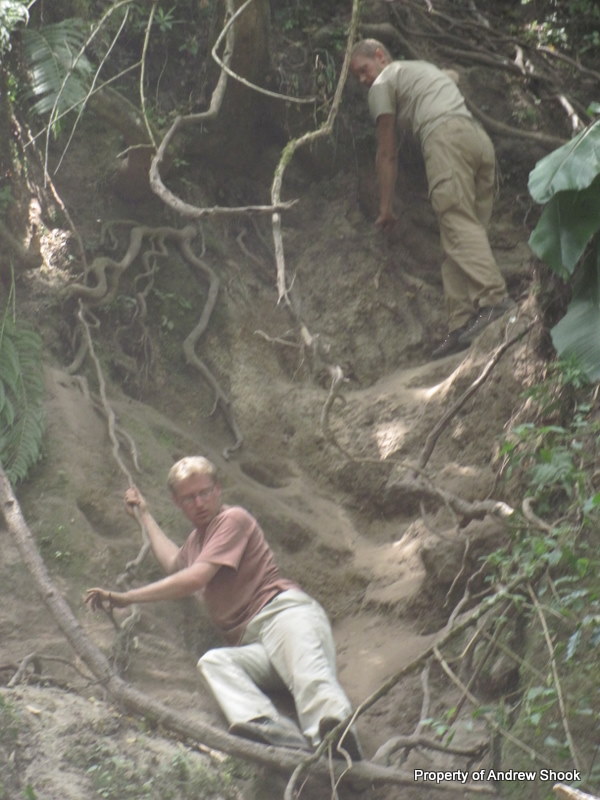
At the lake shore:

Sunday I took off to recover, for the most part. I did have to hike to a friend’s house to start prepare for the Rungwe hike, which was another 2 miles or so. But I felt reasonably recovered by the time we left Monday morning and headed up the mountain. The Rungwe hike is an interesting one as you start out hiking through modern rural Africa, then get to a less modern rural Africa, then in the matter of about 5 feet you’re in Jungle Africa. It’s kind of amusing because upon entering the forest, you immediately drop down probably 50-75 feet to reach a creek (and yes you can drink from it!). It’s the gorgeous setting with trees everywhere and birds calling. There is an occasional monkey (as rungwe has its own species) but they aren’t always around. Anyway, the upward hike begins and goes on forever it seems. Eventually, the trees thin and you start to get peeks of your surroundings. It’s about this time my stomach seems to realize that it’s out of food. So eating is a priority. Then as the trees continue to thin, they eventually give way to bamboo, which is a really cool setting. After some time in the bamboo, you find yourself in a group of scratchy scrub bushes and the last segment of vegetation. Finally, escaping the bushes, it’s a quick climb to the summit of the peak through short grasses and rocks. All in all it takes between 4-5 hours to get up to the summit. However, this time, my Ngozi weakened legs had to rest quite frequently near the end. At the onset of the bamboo, I had to let Andrew, my hiking partner (yes it was two Andrews hiking together :P) go ahead and I came along at a slower pace. Regardless, it was a lovely hike, and although it was hazy we could see Tukuyu, although not all the way to Lake Malawi. Anyway, after an hour or so we returned to my friends, and then continued to the road to catch a dala dala (remnants of a van that acts as a bus). All in all, that hike was around 17 miles giving me my 28 miles in three days. Thank you Google Earth :P
The bamboo forest:

The view from the top:

The monkey is from my first hike of Rungwe but still quite exciting to see!

And here you can see the hike almost in its entirety. We start just out of the picture to the right and work our way up the ridge on the right side of the picture until reaching the summit.

In other news, there was a massive fire in Tukuyu. Some PC friends and I were visiting an acquaintance that does work in the Tukuyu area and were walking back when we met a group of people on the road who were walking into town saying there was a fire at a hardware store. When we reached the top of the hill in town, you could see red colored smoke rising from main street. The flames were about two stories tall by the time we got there and the entire town, it seemed, was out to watch or empty the stores adjacent to the fire. The experience gave me a new perspective on the dangers of fire. For the first time in my life, I actually could see the fire getting out of control. I’ve seen the forest fires on TV but in real life I’ve always felt like fire was something that could be contained to what it already had affected. Here I could see people scrambling to save whatever they could from a building a block away and I couldn’t argue with their logic because the fire did not seem as though it could be stopped from reaching those buildings. Fortunately, it ran out of fuel before it spread too far and only the hardware store burned, but it was a humbling experience knowing the town was at the mercy of the fire. The firetruck from Mbeya even made an appearance although it was after the fire had subsided to well within control. Fortunately, I don’t think anyone was injured and only one store was lost. The area is already back to normal, just with one less business.
Thursday, September 30, 2010
Thoughts well beyond TZ
So in the past I’ve tried to keep this exclusively a Peace Corps related blog, commenting on things from my daily life and occasionally throwing in my thoughts about things that make it here from America. But I’m realizing that daily occurrences in America are actually a part of my life here. My access to information has indeed been set back, but only slightly. I have daily access to the internet, albeit through an expensive choice compared to the US where it is more standard. But still I’m constantly reminded about my connectivity. Be it following a tornadic supercell, or learning of the shooting at UT Austin within an hour or two of it happening. So, due to this fact, I thought I’d break from thoughts on Peace Corps and PC related material and ideology and discuss the things that roam around in my head way more than they should :P
There were two studies recently released that have particular interest to me. The first, and perhaps most obvious, was the downtown development study for Wichita. If you’re interested in the documents, they can be found here! I think it’s the American symbol of prosperity to have a downtown core full of skyscrapers making an identifiable skyline for the world to see. Iconic buildings give us a sense of pride and place. Even the terrorists on 9/11 knew that and took out the two biggest symbols in America. So when someone suggests downtown development, the first mental response is really big, tall buildings. However, the study for the Wichita downtown redevelopment did not suggest new high-rise buildings putting the Epic Center to shame, and I’m finding I agree with the plan. While the goals seem modest at best, I think they are the right focus for the city right now. The city council has had a chronic issue of approving things project by project and figuring it will all congeal into a neighborhood of sorts. Now they have a blueprint on which to build their plans and something to lean on if they want to say no this isn’t something we’re looking for. At the same time it puts their plans out there so developers can see if the plan fits a project they’re interested in. I like consistent plans, but I also appreciate the fact that the plan is not too grandiose. While I’m all for more high-rise construction in the city, I think building from the ground up works better than the sky down. Developing the area as a denser multi-use neighborhood ensures that services are available once someone does become interested in building big and tall. There is no advantage to putting a 30 story building downtown if all that surrounds it is its own parking. That option is available very cheaply and readily, with better highway access too, at the edges of town. Therefore, in order to make the CBD more appealing than say, The Waterfront, the residences and services have to be in place. I would also complement the study on prioritizing transit in the core, as higher density is sustainable when transit is a prominent part of the equation. However, I have A LOT of thoughts on that topic so I’ll leave it for now :P
The second study (found here) is the release of Amtrak’s dream plan for the Northeast Corridor, connection Boston and Washington via NYC and Philly. It’s suggesting a 220mph high-speed train on separate tracks, similar to California’s system, for a tidy sum of $117 billion. Now before sticker shock sets in, let’s remember that the last NEC report issued suggested that the current right-of-way requires $52 billion to be brought up to current standards. I admit, that’s still over double the cost but let’s think about what we’re buying with this. The proposal is about as ambitious as one can get without getting ridiculous. It asks for new tunnels through the center city in Baltimore, Philadelphia, and NYC. But when you consider the fact that doing all that only slightly more than doubles the maintenance costs it seems like a potentially good investment. The report suggests the line would generate a $900 million operation surplus annually (which is getting close to Amtrak’s current budget). It would certainly change the lifestyles of those in the corridor as it suggests that travel times will be shortest on rail, once security and travel from the airport is considered. I’m not really justified in saying whether it is “worth it” or not but I foresee many more studies like this one suggesting the development of HSR in corridors like this (although admittedly not as ideal). We’ll see what comes of this!
I’m noticing a shift in my ideas as to what makes good policy when it comes to urban development. It was not that long ago that I had a build big early and make what you want happen. But as I’m spending time living in a situation where sustainability is such an important part of being effective, I see how sacrificing the day-to-day for the big spectacle can be very dangerous. Now if the government wrote a blank check for the NEC project and work started next month, I’m fairly sure that the project would be well utilized and the benefits would hide the cost. However, the report suggests instead of a one-time payment, committing to a $4.something billion per year plan and make the improvements over 25 years. Building in increments fixes the worst parts of the system first and builds the hype for the rest of the system. Building the downtown core of Wichita with the basics first, then slowly add the eye-candy allows the system to be sustainable. What qualifies as basics and the most needed fixes is always up for debate, but I’m learning how much of the battle is in the implementation, both sequentially and quantitatively. It’s a huge balancing act, and it doesn’t help when the ground is moving underneath you so your support isn’t stable. I can’t say with any confidence that I know this is the case but I think the Interstate system had much more universal support, always standing on solid ground where it is understood to be part of the future. Much of development today has no consensus on what is “the future” so it is a challenge to implement anything sustainably because someone often has a different idea of which way things should be heading. In reality, I’m surprised long-term projects do really ever get done because the people leading them can destroy them so easily. I suppose that’s one of the dangers of democracy, but the security of checks-and-balances is worth the roller coaster for sure.
Anyway, I’m trying to keep my rambling in check, so I’ll stop there. I’d be interested to hear thoughts from those affected by either project because, as one person, I certainly do not have a full view of their significance.
There were two studies recently released that have particular interest to me. The first, and perhaps most obvious, was the downtown development study for Wichita. If you’re interested in the documents, they can be found here! I think it’s the American symbol of prosperity to have a downtown core full of skyscrapers making an identifiable skyline for the world to see. Iconic buildings give us a sense of pride and place. Even the terrorists on 9/11 knew that and took out the two biggest symbols in America. So when someone suggests downtown development, the first mental response is really big, tall buildings. However, the study for the Wichita downtown redevelopment did not suggest new high-rise buildings putting the Epic Center to shame, and I’m finding I agree with the plan. While the goals seem modest at best, I think they are the right focus for the city right now. The city council has had a chronic issue of approving things project by project and figuring it will all congeal into a neighborhood of sorts. Now they have a blueprint on which to build their plans and something to lean on if they want to say no this isn’t something we’re looking for. At the same time it puts their plans out there so developers can see if the plan fits a project they’re interested in. I like consistent plans, but I also appreciate the fact that the plan is not too grandiose. While I’m all for more high-rise construction in the city, I think building from the ground up works better than the sky down. Developing the area as a denser multi-use neighborhood ensures that services are available once someone does become interested in building big and tall. There is no advantage to putting a 30 story building downtown if all that surrounds it is its own parking. That option is available very cheaply and readily, with better highway access too, at the edges of town. Therefore, in order to make the CBD more appealing than say, The Waterfront, the residences and services have to be in place. I would also complement the study on prioritizing transit in the core, as higher density is sustainable when transit is a prominent part of the equation. However, I have A LOT of thoughts on that topic so I’ll leave it for now :P
The second study (found here) is the release of Amtrak’s dream plan for the Northeast Corridor, connection Boston and Washington via NYC and Philly. It’s suggesting a 220mph high-speed train on separate tracks, similar to California’s system, for a tidy sum of $117 billion. Now before sticker shock sets in, let’s remember that the last NEC report issued suggested that the current right-of-way requires $52 billion to be brought up to current standards. I admit, that’s still over double the cost but let’s think about what we’re buying with this. The proposal is about as ambitious as one can get without getting ridiculous. It asks for new tunnels through the center city in Baltimore, Philadelphia, and NYC. But when you consider the fact that doing all that only slightly more than doubles the maintenance costs it seems like a potentially good investment. The report suggests the line would generate a $900 million operation surplus annually (which is getting close to Amtrak’s current budget). It would certainly change the lifestyles of those in the corridor as it suggests that travel times will be shortest on rail, once security and travel from the airport is considered. I’m not really justified in saying whether it is “worth it” or not but I foresee many more studies like this one suggesting the development of HSR in corridors like this (although admittedly not as ideal). We’ll see what comes of this!
I’m noticing a shift in my ideas as to what makes good policy when it comes to urban development. It was not that long ago that I had a build big early and make what you want happen. But as I’m spending time living in a situation where sustainability is such an important part of being effective, I see how sacrificing the day-to-day for the big spectacle can be very dangerous. Now if the government wrote a blank check for the NEC project and work started next month, I’m fairly sure that the project would be well utilized and the benefits would hide the cost. However, the report suggests instead of a one-time payment, committing to a $4.something billion per year plan and make the improvements over 25 years. Building in increments fixes the worst parts of the system first and builds the hype for the rest of the system. Building the downtown core of Wichita with the basics first, then slowly add the eye-candy allows the system to be sustainable. What qualifies as basics and the most needed fixes is always up for debate, but I’m learning how much of the battle is in the implementation, both sequentially and quantitatively. It’s a huge balancing act, and it doesn’t help when the ground is moving underneath you so your support isn’t stable. I can’t say with any confidence that I know this is the case but I think the Interstate system had much more universal support, always standing on solid ground where it is understood to be part of the future. Much of development today has no consensus on what is “the future” so it is a challenge to implement anything sustainably because someone often has a different idea of which way things should be heading. In reality, I’m surprised long-term projects do really ever get done because the people leading them can destroy them so easily. I suppose that’s one of the dangers of democracy, but the security of checks-and-balances is worth the roller coaster for sure.
Anyway, I’m trying to keep my rambling in check, so I’ll stop there. I’d be interested to hear thoughts from those affected by either project because, as one person, I certainly do not have a full view of their significance.
Tuesday, September 28, 2010
Uniqueness and Fantasy
So here in Peace Corps we have a rather large network of media sharing. Favorite shows (Chuck!) are passed around and time is spent (or wasted) watching the ridiculousness of the American cultural addiction to highly over dramaticized versions of life where romance, death, and song are as likely as meeting your friend in the hallway at school. But it made me think about why. We tend to criticize Tanzanian television because half the time it is two people sitting in a room with some alcoholic drink talking, or often yelling, about daily life. Yet, we also think it is amusing that so many people in the third world look at American media and assume we all live these lives that they see on TV. I think that’s a cultural difference I hadn’t really considered until now. We use the media, theatre, and other creative outlets to play out our fantasies and it builds the capacity for dreaming within us as a community. I know there are a lot of us who would love to have our lives run in musical format where significant events were always punctuated by song but we’re not THAT creative to the point where we can do that to any great effect as a people. Yet, here these fantasies are often built on a foundation of reality. Dance and theatre are present but the dance is all still within the confines of a reproduction of a tribal product that has been around for a long time and theatre is rarely punctuated by more than dialogue. I feel like here the prized way of expressing yourself is repeating something widely known, and repeating it very well. Meanwhile, in America uniqueness is heavily valued and when it is produced with quality it hits the spot much more effectively. We love our glitz and glamour and strive for it, even at inappropriate times.
Of course I’m not trying to say one is better than the other but it is interesting how those two ideals tend to come into conflict. I’ve tried to pull creativity out of the students by giving them less rigor in their instructions and the results are nearly disastrous. I take questions until every student finds some sufficient amount of instructions in what I say. I had a group of students doing a lab once where they had thought of an original (well original in that they were the only ones doing it that way) lab and had already produced valid, useful results. Once the rest of the class came up with very similar versions of the experiment that differed dramatically from this group’s, they practically begged me to allow them to change their experiment and take new data. It was incredibly frustrating, considering growing up in America, we tend to encourage uniqueness and focus on appreciating our differences. (Obviously this is a wild generalization and there are many parts of America that are significantly more narrow minded on many issues than even the most stringent of cultures).
There are the ideas in America that you should enjoy what makes you happy, it’s the journey that matters not the destination, etc. I mean, framing a lot of what we do in certain ways can make us look of questionable intelligence. For example, why do people go outside and intentionally let the sun damage their skin while doing nothing but resting? Because it feels good. Why do people spend money on a pair of jeans that costs them twice as much as another perfectly reasonable pair? Because they like the way they feel while wearing them. For all this short term gratification, Americans still have a surprisingly effective work ethic. What I’ve seen here suggests that the basic premise is those who have the tools to work their way up in the culture do so doing whatever is available to them. If the best job they can get is teaching, they do so despite any aversion to truly analytical grading, lesson preparation, or sometimes even standing in front of a class. The phrase “those who can’t do teach” is taken as truth here and teachers often don’t like what they do and the students don’t like that they do them. Even students, if they have an interest in something, but struggle at all, they give it up for the next easiest path to a “decent sized” paycheck.
Obviously there needs to be a balance. There are the people that look at everything as a means to an end and find their life passing them by without any worth or enjoyment. There are also the people who are totally encamped in the live-for-now clan and a good day is measured by how many drinks they can buy that night. I think that’s an understanding I’ve made it a goal to pass on. People here tend to fall on one side or the other and balance is significantly lacking. I would imagine though, if you took a close look at the variations between the two cultures you would find fewer differences in terms of the goals and motivations but mostly just a change in materials, or lack thereof. Yet I think we tend to identify and be aware of this balance (and how we don’t have it) whereas I’m not sure that is the case here. The reasons for that are numerous and not worth trying to recount but the general ease with which information and ideas moves in America plays a large part I think.
Of course I’m not trying to say one is better than the other but it is interesting how those two ideals tend to come into conflict. I’ve tried to pull creativity out of the students by giving them less rigor in their instructions and the results are nearly disastrous. I take questions until every student finds some sufficient amount of instructions in what I say. I had a group of students doing a lab once where they had thought of an original (well original in that they were the only ones doing it that way) lab and had already produced valid, useful results. Once the rest of the class came up with very similar versions of the experiment that differed dramatically from this group’s, they practically begged me to allow them to change their experiment and take new data. It was incredibly frustrating, considering growing up in America, we tend to encourage uniqueness and focus on appreciating our differences. (Obviously this is a wild generalization and there are many parts of America that are significantly more narrow minded on many issues than even the most stringent of cultures).
There are the ideas in America that you should enjoy what makes you happy, it’s the journey that matters not the destination, etc. I mean, framing a lot of what we do in certain ways can make us look of questionable intelligence. For example, why do people go outside and intentionally let the sun damage their skin while doing nothing but resting? Because it feels good. Why do people spend money on a pair of jeans that costs them twice as much as another perfectly reasonable pair? Because they like the way they feel while wearing them. For all this short term gratification, Americans still have a surprisingly effective work ethic. What I’ve seen here suggests that the basic premise is those who have the tools to work their way up in the culture do so doing whatever is available to them. If the best job they can get is teaching, they do so despite any aversion to truly analytical grading, lesson preparation, or sometimes even standing in front of a class. The phrase “those who can’t do teach” is taken as truth here and teachers often don’t like what they do and the students don’t like that they do them. Even students, if they have an interest in something, but struggle at all, they give it up for the next easiest path to a “decent sized” paycheck.
Obviously there needs to be a balance. There are the people that look at everything as a means to an end and find their life passing them by without any worth or enjoyment. There are also the people who are totally encamped in the live-for-now clan and a good day is measured by how many drinks they can buy that night. I think that’s an understanding I’ve made it a goal to pass on. People here tend to fall on one side or the other and balance is significantly lacking. I would imagine though, if you took a close look at the variations between the two cultures you would find fewer differences in terms of the goals and motivations but mostly just a change in materials, or lack thereof. Yet I think we tend to identify and be aware of this balance (and how we don’t have it) whereas I’m not sure that is the case here. The reasons for that are numerous and not worth trying to recount but the general ease with which information and ideas moves in America plays a large part I think.
Sunday, September 19, 2010
A Quick Check-In
So my first post of break falls on the 5th day of break; a product of my attempts to write every day but the inevitable tiredness that befalls me later in the day when I had planned to write my blog post. I saw my friend’s blog sign in screen the other day and I saw she has written 42 posts to my 19, and she doesn’t have access to the internet as frequently as I do. Oh well, it’s not a real issue, just thought I’d vocalize my guilt for not writing more often.
Current news in the area isn’t too exciting. That’s mostly because I’m on break. I have a tentative plan to do some hiking at the beginning of October with a friend of mine. He’s in the previous class so he’s sort of doing a farewell tour so it’ll be fun to hit the highlights!
I’m trying to be productive every day and work a little bit on my projects. The big ones are my time management presentation, an AIDS day my fellow volunteer and I are trying to organize for the end of next month, more Kiswahili studying with a larger application approach, more consistent blogging, and a full clean of the house. I have two articles to really work through on my plate currently. One is material I was given by a grad student from the Cornell Psych department in response to an email I sent my Intro Psych prof at Cornell. He specializes in sleep and it’s affects on productivity and lifestyle so I’m hoping I’ll be able to use it to make a pretty impactful presentation! As for my house, I think if I can buy wood and build a set of shelves in addition to the one I found in the house that would really solve a lot of issues. Organization has been troublesome and I’m realizing I really do need to hang a lot of my clothes which I cannot do here. Dad will be happy to hear, that I’m taking this with an approach where everything has to have a place or it has to go. My room is significantly more livable and my extra room is much more organized. Next is the office/guest bedroom which has become a dumping ground for all that “extra” stuff so we’ll see how this turns out.
Not much else is coming to mind. I’m still working on The Uplift War in terms of my reading ventures and the cats are doing well. They did bring a dead bat into the house the other day which has made me consider getting them rabies shots if it’s not too difficult. The election cycle is starting to seep into my life over here (Oh! I have to get my absentee ballot!) so I can only imagine it is getting quite intense on the American side. Seems like people are generally upset with the situation in the states but I fully admit I’m too removed to know who to blame. I’ll have to take some time over the next few weeks to educate myself for voting.
Sorry for so little to say. Hopefully in the coming days I’ll have specific issues to discuss and generally be more interesting. I guess until then, I’ll wish you all well!
Current news in the area isn’t too exciting. That’s mostly because I’m on break. I have a tentative plan to do some hiking at the beginning of October with a friend of mine. He’s in the previous class so he’s sort of doing a farewell tour so it’ll be fun to hit the highlights!
I’m trying to be productive every day and work a little bit on my projects. The big ones are my time management presentation, an AIDS day my fellow volunteer and I are trying to organize for the end of next month, more Kiswahili studying with a larger application approach, more consistent blogging, and a full clean of the house. I have two articles to really work through on my plate currently. One is material I was given by a grad student from the Cornell Psych department in response to an email I sent my Intro Psych prof at Cornell. He specializes in sleep and it’s affects on productivity and lifestyle so I’m hoping I’ll be able to use it to make a pretty impactful presentation! As for my house, I think if I can buy wood and build a set of shelves in addition to the one I found in the house that would really solve a lot of issues. Organization has been troublesome and I’m realizing I really do need to hang a lot of my clothes which I cannot do here. Dad will be happy to hear, that I’m taking this with an approach where everything has to have a place or it has to go. My room is significantly more livable and my extra room is much more organized. Next is the office/guest bedroom which has become a dumping ground for all that “extra” stuff so we’ll see how this turns out.
Not much else is coming to mind. I’m still working on The Uplift War in terms of my reading ventures and the cats are doing well. They did bring a dead bat into the house the other day which has made me consider getting them rabies shots if it’s not too difficult. The election cycle is starting to seep into my life over here (Oh! I have to get my absentee ballot!) so I can only imagine it is getting quite intense on the American side. Seems like people are generally upset with the situation in the states but I fully admit I’m too removed to know who to blame. I’ll have to take some time over the next few weeks to educate myself for voting.
Sorry for so little to say. Hopefully in the coming days I’ll have specific issues to discuss and generally be more interesting. I guess until then, I’ll wish you all well!
Wednesday, September 8, 2010
An update
So my situation has continued to develop into an interesting mix of nothing and piles of work at the same time. I'm learning how a job can take as much or little time as you want to give it. I want to be thorough on preparing my Form VI math class for their exam since my work load has been siginificantly reduced in the teaching department. I have such a good model to work from in my high school math teacher Mr. Reimer. I realize that it wasn't just his test prep work that got such consistently high-quality results but his results speak for themselves and are therefore my foundation. We just took a test of the material we reviewed due to its higher difficulty and we have a lot of ground to cover but we also have some time. So I'm trying to make my review the best it can be.
In other non-classroom work, my list seems to grow ever longer of things I would like to do. I recently realized I probably could have done PCV of the week, which I had not applied for due to my perception that there were many more qualified than I. This realization left me bummed but I've realized that I should have been more confident or this situation wouldn't have happened. So, I'm using it to motivate myself to fix the things I thought I lacked: Kiswahili skills and a solid outside project.
I'm trying to ramp up my studying to even more than the one lesson a day. I'm currently doing two lessons and after this week will start more intensive vocabulary work. It's hard to place a finish line but I have a general idea of what I want to be able to do. I want to feel comfortable enough in pretty much any conversation where as now I know I'll survive but not necessarily get everything. Future phases are book reading and listening to the radio or tv. I know this has been a never-ending issue but that's what happens when you live in a country that speaks a different language :P
As for the outside project, the library is going....slowly. I had hopes initially that things would go faster than standard Tanzanian pace but I forgot that the project allowing the library work to happen is being run by others so alas, I'm finding little things to do to fill the time between now and whenever it is that we move the library. I also have made some progress in the hypothetical sense about a new building for the computers and library. The reality is the school is going to have additional students living on the campus next A-level year so the need for a new building is inevitable. However, I think we planning we can make it the library and turn the current one back into the dorm space it is right now. So that's very long term. More practical and in reach is the reorganization of the library into a bigger room with more shelves. I think the biggest change I'm aiming to make is still making it available to students at more hours than one person can offer, but we'll see what we can do.
My idea of making a time management presentation is still hanging around but it has kind of fizzled to the background for now. That's not to say I wouldn't appreciate any articles on sleep patterns, effective study skills, or extracurriculars. I would definitely like to pick this up during my break, so we'll see how it goes.
But the new development is an AIDS day in coordination with my sitemate Katie. We're looking at getting our schools together and teaching the students about the situation here in Mbeya and what they can do about it. It's still in the developmental stages but we've made some contacts and got some agreements. Even though AIDS education is very common around here, there is an issue with the it going from the classroom or seminar to practice in the real world. AIDS is rampant, nearly one in every five or six people has it and much of that is due to the disconnect between awareness and practical applications of education. For example, the students here learn in their Biology class the process for putting on a condom but many school officials feel having a condom demonstration in school is promoting sexual activity. That's an understandable concern but we volunteers often find ourselves arguing for a more practical approach because the age at which people become sexually active here is surprisingly low and often they don't have the proper education by that age. So I will let you know how that progresses! It's exciting to see something start to come together that could really affect someone's life in such a big way as helping them avoid HIV and AIDS!
Other than that, not a whole lot is going on. I saw Kikwete (the TZ prez) last week in a campaign "speech" (it was more of a list of things he did). The cats are doing well and are getting quite big! I'm not sure how much more they'll grow but it can't be too much. That's it for now, I hope things are good in the states!
In other non-classroom work, my list seems to grow ever longer of things I would like to do. I recently realized I probably could have done PCV of the week, which I had not applied for due to my perception that there were many more qualified than I. This realization left me bummed but I've realized that I should have been more confident or this situation wouldn't have happened. So, I'm using it to motivate myself to fix the things I thought I lacked: Kiswahili skills and a solid outside project.
I'm trying to ramp up my studying to even more than the one lesson a day. I'm currently doing two lessons and after this week will start more intensive vocabulary work. It's hard to place a finish line but I have a general idea of what I want to be able to do. I want to feel comfortable enough in pretty much any conversation where as now I know I'll survive but not necessarily get everything. Future phases are book reading and listening to the radio or tv. I know this has been a never-ending issue but that's what happens when you live in a country that speaks a different language :P
As for the outside project, the library is going....slowly. I had hopes initially that things would go faster than standard Tanzanian pace but I forgot that the project allowing the library work to happen is being run by others so alas, I'm finding little things to do to fill the time between now and whenever it is that we move the library. I also have made some progress in the hypothetical sense about a new building for the computers and library. The reality is the school is going to have additional students living on the campus next A-level year so the need for a new building is inevitable. However, I think we planning we can make it the library and turn the current one back into the dorm space it is right now. So that's very long term. More practical and in reach is the reorganization of the library into a bigger room with more shelves. I think the biggest change I'm aiming to make is still making it available to students at more hours than one person can offer, but we'll see what we can do.
My idea of making a time management presentation is still hanging around but it has kind of fizzled to the background for now. That's not to say I wouldn't appreciate any articles on sleep patterns, effective study skills, or extracurriculars. I would definitely like to pick this up during my break, so we'll see how it goes.
But the new development is an AIDS day in coordination with my sitemate Katie. We're looking at getting our schools together and teaching the students about the situation here in Mbeya and what they can do about it. It's still in the developmental stages but we've made some contacts and got some agreements. Even though AIDS education is very common around here, there is an issue with the it going from the classroom or seminar to practice in the real world. AIDS is rampant, nearly one in every five or six people has it and much of that is due to the disconnect between awareness and practical applications of education. For example, the students here learn in their Biology class the process for putting on a condom but many school officials feel having a condom demonstration in school is promoting sexual activity. That's an understandable concern but we volunteers often find ourselves arguing for a more practical approach because the age at which people become sexually active here is surprisingly low and often they don't have the proper education by that age. So I will let you know how that progresses! It's exciting to see something start to come together that could really affect someone's life in such a big way as helping them avoid HIV and AIDS!
Other than that, not a whole lot is going on. I saw Kikwete (the TZ prez) last week in a campaign "speech" (it was more of a list of things he did). The cats are doing well and are getting quite big! I'm not sure how much more they'll grow but it can't be too much. That's it for now, I hope things are good in the states!
Subscribe to:
Posts (Atom)
